Its been a long, busy winter here. We are very excited to share our newest project with you- the Summer Semester, which will focus on learning the skills to build a tiny house.
To view the blog, follow the following link, or select the Tiny House Blog link on the list of links to the right.Stone Soup Tiny House Blog
The Stone Soup Institute is an international school offering courses of study which integrate traditional and contemporary practices and knowledge in the Agrarian Arts & Sciences, Crafts and Fine Arts.
Stone Soup Institute Website
Stone Soup Tiny House Blog
Stone Soup Flickr Stream
Stone Soup Institute Website
Stone Soup Tiny House Blog
Stone Soup Flickr Stream
Wednesday, April 2, 2014
Tuesday, April 1, 2014
Summer Semester ( May 15 - Aug 15)
As Winter begins to wind down the days are growing increasingly longer, the buds on the trees begin to swell and the sap begins to flow. We find ourselves well rested after a Winter of long nights and as our energy begins to surge we are once again reminded that we are not separate from the world around us.
Our thoughts turn to Spring as we contemplate plowing a new garden plot, starting seedlings, buying piglets and chicks, wild harvesting, and wine and beer making will be filling our farming days. We are sawing lumber for,cold frames, chicken tractors, and a small greenhouse(from our stack of salvaged windows). Raised beds and barn rafters, a hog house and pen, and windows to trim our shop. As the Tiny House movement gains momentum we will begin construction on our third one, and put a great deal of focus on learning the skills to plan and build a tiny house on a movable trailer frame.
To this end, Stone Soup Institute is offering a Spring/Summer semester to four students who are curious and adventuresome enough to explore the learning opportunities on a small homestead in coastal Maine.
The seafood season will be in full vigor as the days turn past the Summer Solstice. We will spend long days in the gardens and fields and many long evenings around the Mediterranean Grill and outdoor Bake Oven feasting on the fruits of our labor.
The Curriculum
- Gardening and Crops
- planting and tending seedlings
- direct seeding crops
- Animal Husbandry
- selection and care of piglets
- selection and care of broilers and laying chicks
- use and care of draft horses
- Building
- tiny house
- cold frame
- greenhouse
- hog pen
- chicken tractor
- raised beds
- installation of windows and doors
- Craft
- wild harvesting
- wine making
- beer making
- baking in a wood-fired outdoor oven
- grilling on Mediterranean style Community Grill
- Introduction to Fiber Arts
- Introduction to Blacksmithing
The educational experience is designed around the practical skills and seasonal rhythms associated with maintaining a small homestead.
The primary delivery of the curriculum is through the hands-on experience where students are expected to be self-motivated and able to self-evaluate, as there is no required reading, or testing.
Living Arrangements
Participants in this semester will live in a 2000 square foot house
built by Jim Cornish, the co-founder of Stone Soup Institute. The house
is heated only with wood from a cast iron Jotul in the south and in the
north end, a brick Finnish fireplace, with a bake oven and hot water
heater.
There are three bedrooms available to students, one in the north end
over the Finnish fireplace which sleeps two; one in the south end and a
loft in the west end which will accommodate one each.
Students will prepare meals using the wood stoves and electric stove and serve on a common table in front of the fireplace.
There is one television with cable, VCR and computer access.
Social Opportunities
Stone Soup Institute is located on Harpswell Neck, a peninsula that
is nine miles long and ½ mile wide at its widest point. There are miles
of shoreline to explore within walking distance of the house, miles of
public trails for snow shoeing and cross country skiing.
A small general store and post office are ¼ mile from the house.
Brunswick, the closest town to Harpswell, is nine miles north. It is a
typical New England college town with movie theatres, libraries,
restaurants, small shops, etc. A health food store and Farmers Market
provide opportunities to buy provisions and visit with other farmers in
the area.
Tuition, Fees and Dates
Spring Semester: May 15, 2013 – August 15, 2013
Fees: $3400 which includes full instructional program, seminars, and room and board.
Click here to download an application form.
Fees: $3400 which includes full instructional program, seminars, and room and board.
Click here to download an application form.
The Spring Semester at Stone Soup promises to be physically demanding, emotionally challenging, spiritually expansive, and intellectually stimulating. We hope that you are ready to stand in a place where our past meets our future and explore the possibilities.
Monday, March 3, 2014
Curing and Smoking Meat
From the pigs we processed this winter, we cured and smoked the hams, bacon, and most of the shoulders. They came out amazingly well. We gathered information from books and other farmers to devise a system that fit within our resource constraints.
Here is the smoker. A fire is built in the stove, and the smoke is vented out to where the meat is hanging.
This bacon has been curing in the curing mixture. It was hung here so we can spray the salt off, so that it doesn't get overly salty.
The meat is hung in the smoker. The circle in the middle is where the smoke will come in.
Here is the smoker closed up.
Many a late night was devoted to grinding sausage. Here we have some smoked kielbasa- another amazing blessing from the pig.
Here is the smoker. A fire is built in the stove, and the smoke is vented out to where the meat is hanging.
This bacon has been curing in the curing mixture. It was hung here so we can spray the salt off, so that it doesn't get overly salty.
The meat is hung in the smoker. The circle in the middle is where the smoke will come in.
Here is the smoker closed up.
![]() |
| Inside the smoker. |
![]() |
| The final product, hanging in the house. We cut the bacon into usable sizes, and froze it. This bacon was hands down the best bacon that most people surveyed had ever eaten. |
Saturday, March 1, 2014
Butchering Pigs
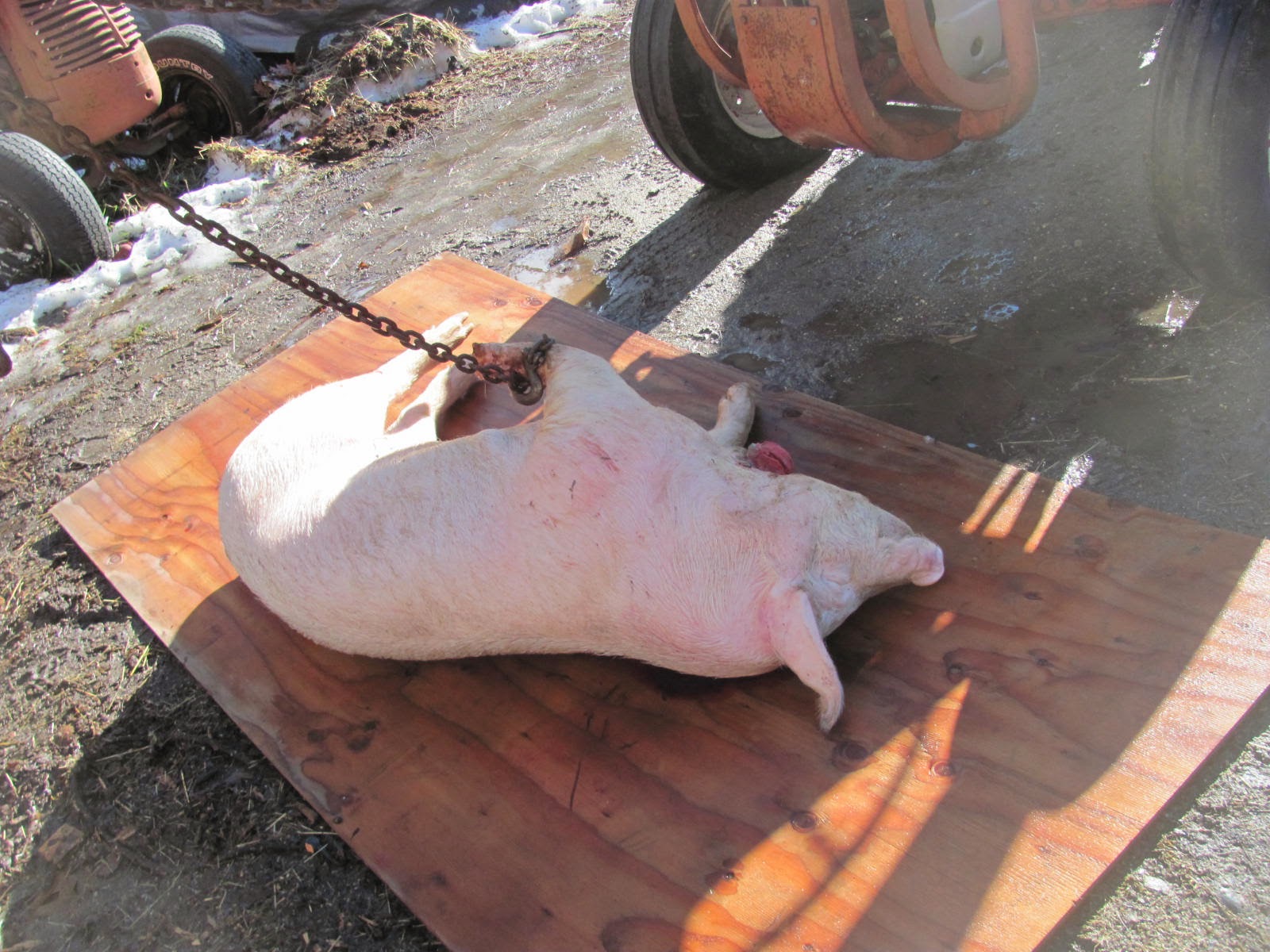
This winter, we processed the pigs we have been raising. When we slaughter animals here, it is done with song and with ceremony, and in the spirit of gratitude.
In the image above, the slaughtered pig is getting prepared to be hoisted up into the hot water bath. The hot water will help us to remove the stiff hair from the pig with ease.
The pig was but in half with a electric saw. The two halves were hung in the cool barn over night. The timing of slaughter is very important. The temp needs to be very col, but not dip below freezing while they hang over night. The next day, we processed the meat.
Here is pig has been cut into three. There is the back third, which will be the ham, the middle third, where the ribs, chops and bacon come from, and the shoulder. Sausage will be made from any of these pieces.
Here we see that Jimmy is happy with this ham.
In the image above, the slaughtered pig is getting prepared to be hoisted up into the hot water bath. The hot water will help us to remove the stiff hair from the pig with ease.
Here the hair is being removed from the pig.
Here is pig has been cut into three. There is the back third, which will be the ham, the middle third, where the ribs, chops and bacon come from, and the shoulder. Sausage will be made from any of these pieces.
Sunday, May 26, 2013
Fall Semester
As the Fall season really begins to come fully into it's own, the days are considerably shorter, the weather is beginning to take on a chill, the trees are in full Fall color, the wild Mushroom harvest is in full swing and the garden has gone past its full vigor.Most of the canning and freezing are done but there are still Pigs and Chickens to butcher, beets,carrots and rutabaga's to put in the cellar.We have made wine from the Summer fruit and now it is time to make wine from Apples, Pears and Peaches. It is time to store the firewood for this Winter and start cutting firewood for next Winter. As we are driven inside earlier by the shortening days there will be more time for making music and more elaborate cooking.The social gatherings will take on the flavors of the Fall season as the house is filled with the smells of Apple Pie, Pumpkin Donuts and Mulled Cider.
To this end Stone Soup Institute is offering a Fall Semester to four students who are curious and adventuresome enough to explore the experiential learning opportunities on a small homestead in Maine.
Curriculum:
- Gardening and Crops
- Storing root vegetables for Winter
- Cover Cropping
- Planting garlic
- Threshing dry beans
- Shelling corn
- Saving seed from fall crops
- Animal Husbandry
- Butchering pigs
- Daily care of laying hens
- Butchering broiler chickens
- Daily care of draft horses
- Logging with draft horses
- Craft
- Wild harvesting mushrooms
- Wine making
- Baking in a wood-fired outdoor oven
- Introduction to Fiber Arts
- Introduction to Blacksmithing
The educational experience is designed around the practical skills and seasonal rhythms associated with maintaining a small homestead. The primary delivery of the curriculum is through the hands-on experience where students are expected to be self-motivated and able to self-evaluate, as there is no required reading, or testing.
Living Arrangements
Participants in this semester will live in a 2000 square foot house
built by Jim Cornish, the co-founder of Stone Soup Institute. There is also 16 foot diameter tipi and campsites available.
In the house, there are two bedrooms available to students; one in the north end which sleeps two; one in the south end. Students will prepare meals using the electric stove, outdoor grill and bake oven. Meals are served on a common table. There is one television with cable with VCR and DVD. There is computer access and wireless internet.
Social Opportunities
Stone Soup Institute is located on Harpswell Neck, a peninsula that
is nine miles long and ½ mile wide at its widest point. There are miles
of shoreline to explore within walking distance of the house, miles of
public trails for hiking.
A small general store and post office are ¼ mile from the house.
Brunswick, the closest town to Harpswell, is nine miles north. It is a
typical New England college town with movie theatres, libraries,
restaurants, small shops, etc. A health food store and Farmers Market
provide opportunities to buy provisions and visit with other farmers in
the area.
Tuition, Fees and Dates
Spring Semester: Oct 15 – Dec 15, 2013
Fees: $2300 which includes full instructional program, seminars, and room and board.
Click here to download an application form.
Fees: $2300 which includes full instructional program, seminars, and room and board.
Click here to download an application form.
Stone Soup Institute
298 Allen Point Road, Harpswell, ME 04079, USA
Phone: 207-833-2884
E-mail: mail@stone-soup-institute.org
Monday, May 20, 2013
Another Cycle Begins
As the light rain falls on the Corn and Peas we planted yesterday I take some time to reflect on last years garden. Like most years there were some things that did well and others that did not. The Cilantro and Basil did not germinate well, the beans all got the Mosaic Virus, and the Squash and Cucumbers died from Squash Mildew but not before yielding 29 Butternut Squash and 37 quarts of pickles and all the Cucumbers that we could eat. All else did fantastic. From a 6,300 Square Foot garden we ate all we wanted and stored the surplus for Winter. We canned :
28 quarts of Tomato Juice
18 pints of Salsa
10 pints of Ketchup
We froze:
19 quarts of Spaghetti Sauce
6 gallons of Tomatoes
10 pints of Shell Beans
10 pints of Peas
11 pints of Sugar Snap Peas
In the cellar we put in:
1 1/2 bushels of Carrots
1 1/2 bushels of Beets
2 bushels of Rutabagas
We dehydrated 11 quarts of Tomatoes and 11 gallons of Mushrooms, canned 4 quarts of Mushrooms and pickled 10 pints of Fiddle heads that we wild harvested.
We made 10 pints of Pear Butter and 12 pints of Peach Jam from trees around the neighborhood that have been abandoned.
We made:
4 gallons of Raspberry Wine
5 gallons of Rhubarb Wine
5 gallons of Dandelion Wine
5 Gallons of Pear Wine
5 Gallons of Elderberry Wine
5 gallons of Peach Wine
We planted Byron Flint Corn which we ate all Winter and still have enough to last two more Years.
We raised 30 LaRouge Broiler Chickens for the freezer
Some of our bounty is long gone and some is still bountiful. We are adjusting, and planning and planting,singing and celebrating as the new Season unfolds.
It is indeed Magnificent to bring the cycle around full.
Monday, February 18, 2013
Spring/Summer Semester 2013
Spring/Summer Semester 2014
As Winter begins to wind down the days are growing increasingly longer, the buds on the trees begin to swell and the sap begins to flow. We find ourselves well rested after a Winter of long nights and as our energy begins to surge we are once again reminded that we are not separate from the world around us.Our thoughts turn to Spring as we contemplate plowing a new garden plot, starting seedlings, buying piglets and chicks, wild harvesting, and wine and beer making will be filling our farming days. We are sawing lumber for,cold frames, chicken tractors, and a small greenhouse(from our stack of salvaged windows). Raised beds and barn rafters, a hog house and pen, and windows to trim our shop.
As the Tiny House movement gains momentum we will begin construction on our third one to sell as part of our fundraising campaign.
The seafood season will be in full vigor as the days turn past the Summer Solstice. We will spend long days in the gardens and fields and many long evenings around the Mediterranean Grill and outdoor Bake Oven feasting on the fruits of our labor.
To this end, Stone Soup Institute is offering a Spring/Summer semester to four students who are curious and adventuresome enough to explore the learning opportunities on a small homestead in coastal Maine.
The Curriculum
- Gardening and Crops
- planting and tending seedlings
- direct seeding crops
- Animal Husbandry
- selection and care of piglets
- selection and care of broilers and laying chicks
- use and care of draft horses
- Building
- tiny house
- cold frame
- greenhouse
- hog pen
- chicken tractor
- raised beds
- installation of windows and doors
- Craft
- wild harvesting
- wine making
- beer making
- baking in a wood-fired outdoor oven
- grilling on Mediterranean style Community Grill
- Introduction to Fiber Arts
- Introduction to Blacksmithing
The educational experience is designed around the practical skills and seasonal rhythms associated with maintaining a small homestead.
The primary delivery of the curriculum is through the hands-on experience where students are expected to be self-motivated and able to self-evaluate, as there is no required reading, or testing.
Living Arrangements
Participants in this semester will live in a 2000 square foot house
built by Jim Cornish, the co-founder of Stone Soup Institute. There is also a 16 foot diameter tipi and campsites available.
In the house, there are two bedrooms available to students; one in the north end and one in the south end each will sleep two students.
Students will prepare meals using the electric stove, outdoor grill and bake oven. Meals are served on a common table.
There is one television with cable, VCR and DVD. There is computer access and wireless internet.
Social Opportunities
Stone Soup Institute is located on Harpswell Neck, a peninsula that
is nine miles long and ½ mile wide at its widest point. There are miles
of shoreline to explore within walking distance of the house, miles of
public trails for hiking.
A small general store and post office are ¼ mile from the house.
Brunswick, the closest town to Harpswell, is nine miles north. It is a
typical New England college town with movie theatres, libraries,
restaurants, small shops, etc. A health food store and Farmers Market
provide opportunities to buy provisions and visit with other farmers in
the area.
Tuition, Fees and Dates
Spring Semester: May 15 – August 15, 2013
Fees: $3400 which includes full instructional program, seminars, and room and board.
Click here to download an application form.
Fees: $3400 which includes full instructional program, seminars, and room and board.
Click here to download an application form.
The Spring Semester at Stone Soup promises to be physically demanding, emotionally challenging, spiritually expansive, and intellectually stimulating. We hope that you are ready to stand in a place where our past meets our future and explore the possibilities.
Stone Soup Institute
298 Allen Point Road, Harpswell, ME 04079, USA
Phone: 207-833-2884
E-mail: mail@stone-soup-institute.org
The Art of Labor
At times it seems that the art of physical work has been forgotten. It does not seem to be thought of, even in the negative sense, as in, "that work is for simple people who are not smart enough to get better work." Though it feels culturally forgotten, it is not gone.
I think about that great cultural amnesia, and feel pain about it, because there is real joy and beauty in work that is shaped by the realities of the earth. In learning how to live within the rhythms and hymns of the earth, we learn the art of stillness; the challenging art of attention to reality. What you believe will happen matters little, when it differs from the reality of what actually is happening. It is only from that quiet, still, attentive place that we truly work with the earth, instead of trying to change and control it. We wrap our days around the rhythms of the earth, and live in the happy cradle of the earth- where all things will become balanced, where more time will always come, where real rest will happen at the end of each day, and each year is marked with what we have learned, not what we have failed at, or done wrong. We are lifted and carried by the energy that awakens the world, and we rest with the darkness that tells all living things to sleep.
The play of children gives way to the work of adults, and we put down our head and pull upon ourselves a weight that no one can gracefully bear. But the more I consider, the more I believe the reality of play and joy, that we are so sure of as children, is the real one. Why should we not play when we work? Why should we not feel joy within our bodies as we interact with the alive world that we inhabit? Why should the way the world is put together ever stop fascinating us? In learning something well, you realize only that you know so little, and that we have this precious medium of time to feel and know this endlessly expanding place. Calvin Luther Martin, author of The Way of the Human Being, wrote tenderly, and very well about this. Here he writes about a story teller- a man Native to the Arctic:
" The old man would speak of a world bristling and crackling with power, the power of origination and deepest formation, which cared for everything- took care of everything- even human beings. The earth, he said, is not a place to fear. The problem was that adults had lost their nerve, lost faith in the marrow of it all. Children, he believed, still hold the mighty secret of trust. It was the lesson of the child to the adult: absolute trust. Once trust began percolating back into the soul again, humans would behold the liberating of those colossal earthly powers that now lay silent under the spell of our bad faith. The earth would be alive again and human beings would stop living lives of waiting, stop living in the curse of time and history, to live instead in the still point of beauty."
I think about that great cultural amnesia, and feel pain about it, because there is real joy and beauty in work that is shaped by the realities of the earth. In learning how to live within the rhythms and hymns of the earth, we learn the art of stillness; the challenging art of attention to reality. What you believe will happen matters little, when it differs from the reality of what actually is happening. It is only from that quiet, still, attentive place that we truly work with the earth, instead of trying to change and control it. We wrap our days around the rhythms of the earth, and live in the happy cradle of the earth- where all things will become balanced, where more time will always come, where real rest will happen at the end of each day, and each year is marked with what we have learned, not what we have failed at, or done wrong. We are lifted and carried by the energy that awakens the world, and we rest with the darkness that tells all living things to sleep.
The play of children gives way to the work of adults, and we put down our head and pull upon ourselves a weight that no one can gracefully bear. But the more I consider, the more I believe the reality of play and joy, that we are so sure of as children, is the real one. Why should we not play when we work? Why should we not feel joy within our bodies as we interact with the alive world that we inhabit? Why should the way the world is put together ever stop fascinating us? In learning something well, you realize only that you know so little, and that we have this precious medium of time to feel and know this endlessly expanding place. Calvin Luther Martin, author of The Way of the Human Being, wrote tenderly, and very well about this. Here he writes about a story teller- a man Native to the Arctic:
" The old man would speak of a world bristling and crackling with power, the power of origination and deepest formation, which cared for everything- took care of everything- even human beings. The earth, he said, is not a place to fear. The problem was that adults had lost their nerve, lost faith in the marrow of it all. Children, he believed, still hold the mighty secret of trust. It was the lesson of the child to the adult: absolute trust. Once trust began percolating back into the soul again, humans would behold the liberating of those colossal earthly powers that now lay silent under the spell of our bad faith. The earth would be alive again and human beings would stop living lives of waiting, stop living in the curse of time and history, to live instead in the still point of beauty."
Monday, February 4, 2013
A day at SSI
Horse powered logging with the winter semester crew, homemade fresh ground cornbread.
Video footage and editing by Dan Paluska
Saturday, January 26, 2013
Building a Logging Sled/Scoot
One of the first projects that the students have completed is a logging scoot. This is being used to drag wood out of the woodlot. It is then put into a jig( see below) to buck up with a chainsaw to a size that can fit into the wood stove and the Finnish fireplace.
The shoes where made of oak and were nailed into predrilled holes. These holes were filled with plugs, so there the bottom of the shoe is smooth and without any drill holes.
Posts were made from wood to fit into brackets. These hold the wood on the sled when the sled is in motion.
At this point the sled is finished. We used it for a few days. The group decided that a barrier between the driver and the horses would serve as a balancing aid for new drivers.
In the above pictures the floor planks can be seen. This is where the driver stands before wood is loaded onto the scoot. The images below show the detail of the harnesses and eveners.
Bucking Jig
Saturday, January 12, 2013
Horse Logging Semester at Stone Soup has Started!
The Horse logging semester has started here at SSI. The days are full of the choreing, learning, cooking, talking, resting, eating, and music. The students arrived here seven days ago, and spent a few days getting acclimated to the environment and the horses. They took a few trips for supplies, axe heads, safety gear, and the like.
They are driving the horses- as I write they are driving the Marcus and Gus as a team. They are in the process of learning to build a logging sled. To that end, earlier today the students learned how to heat up rusted bolts on the old logging sled with a torch, and remove the useful parts from it.
They have begun using chainsaws to buck up firewood, and some tree felling has began as well. Some of these trees are standing deadwood, which will be used for firewood in the house.
We are all living together- taking turns cooking, cleaning, keeping an eye on the fires, and tending to the horses. In the evenings we eat, talk, and often play music, as the house is completely packed with musicians and musical instruments.
We talk about things we agree on, we disagree on things, we see different perspectives, we clarify our perspectives. We get overwhelmed with the activity and go to be by ourselves for while, and come back, and constantly seem to find ourselves happy to be here. Happy to feel like a person working with our hands, with the forces of the earth.
There is always a deeper story than the activities of the day though. I can not speak for anyone but myself, but this is the deeper story I hear, as this all begins:
Learning something in this way is different, because this is all about the feel of it. It is knowledge that lives in our senses. The ability is within your hands, in light touch, in patience, in perseverance, and in the clear and calm mind of the willing learner. It takes time to sink in- but soon, the world you live in speaks back. It says that you are capable, as your hands learn to feel something your mind could never know. It says that you are wise as your instincts begin to communicate something that doesn't have a language to it. It says that your identity is beautiful, as each day, you look outside, and see that world is indeed a hopeful, beautiful place, and you are not separate from it. When a human works with hard earned skill- gained only by time, clarity, gentleness, and patience, it is as if the work rises to meet them- Work is no longer work, but a dance that speaks only of love, of complete devotion, or complete willing dependance- it is a form of worshiping reality that a happy few get to know. It is a meditation and as profound a thing as can be found in any house of worship. It is one way we have been given to speak to the earth, and the conduit through which the earth speaks back. To have a life of leisure- to be done with work, is a common dream of some Americans. But, like so many other things, the absolute opposite seems to be the truth. To know how to work, with wisdom and skill, is real freedom, peace and happiness. The pursuit here is deeper than knowledge- its knowing.
They are driving the horses- as I write they are driving the Marcus and Gus as a team. They are in the process of learning to build a logging sled. To that end, earlier today the students learned how to heat up rusted bolts on the old logging sled with a torch, and remove the useful parts from it.
They have begun using chainsaws to buck up firewood, and some tree felling has began as well. Some of these trees are standing deadwood, which will be used for firewood in the house.
We are all living together- taking turns cooking, cleaning, keeping an eye on the fires, and tending to the horses. In the evenings we eat, talk, and often play music, as the house is completely packed with musicians and musical instruments.
We talk about things we agree on, we disagree on things, we see different perspectives, we clarify our perspectives. We get overwhelmed with the activity and go to be by ourselves for while, and come back, and constantly seem to find ourselves happy to be here. Happy to feel like a person working with our hands, with the forces of the earth.
There is always a deeper story than the activities of the day though. I can not speak for anyone but myself, but this is the deeper story I hear, as this all begins:
Learning something in this way is different, because this is all about the feel of it. It is knowledge that lives in our senses. The ability is within your hands, in light touch, in patience, in perseverance, and in the clear and calm mind of the willing learner. It takes time to sink in- but soon, the world you live in speaks back. It says that you are capable, as your hands learn to feel something your mind could never know. It says that you are wise as your instincts begin to communicate something that doesn't have a language to it. It says that your identity is beautiful, as each day, you look outside, and see that world is indeed a hopeful, beautiful place, and you are not separate from it. When a human works with hard earned skill- gained only by time, clarity, gentleness, and patience, it is as if the work rises to meet them- Work is no longer work, but a dance that speaks only of love, of complete devotion, or complete willing dependance- it is a form of worshiping reality that a happy few get to know. It is a meditation and as profound a thing as can be found in any house of worship. It is one way we have been given to speak to the earth, and the conduit through which the earth speaks back. To have a life of leisure- to be done with work, is a common dream of some Americans. But, like so many other things, the absolute opposite seems to be the truth. To know how to work, with wisdom and skill, is real freedom, peace and happiness. The pursuit here is deeper than knowledge- its knowing.
Thursday, October 4, 2012
It has been a long, busy, beautiful Summer here at Stone Soup. The horses are fat, the garden was fantastic, the broiler chickens are coming along nicely(except for the five that the fox bit the heads off from), the days are getting shorter and cooler and the full weight of the Fall harvest is upon us.As our days run on into the night, sometimes till 11:00, we are thinking of winter.
Winter is a little quieter around here when the long nights drive us inside by 4:30, but there is still plenty to do. Aside from the usual daily chores there will be the Winter chores to prepare us for the Seasons ahead. This Winter we will be cutting and splitting firewood for next Winter and selecting the trees that we will need to saw into lumber for a new roof for a barn that we took down in Topsham last Fall and will re-construct next Summer here at S.S.I. The horses have been on light duty all Summer and I think that they will be happy for a daily routine of logging. We are currently accepting applications for four students for a Winter semester that will focus mainly on Horse Logging. Anyone interested in applying can take a look at the full Course Description on our web-site at www.stone-soup-institute.org
Sunday, August 12, 2012
Highlights of the Past Year
Well, it has been along time since I wrote a post, but a lot of wonderful things have a happened- the garden is in amazing shape, its been the best year for berries that I have known, and there has been a number of building projects in the works. Notable buildings are a pig pen, and a mobile chicken tractor. Thirty-one "Freedom Rangers" broiler chicks arrrived about a week and half ago-they will be the first residents of the chicken tractor. I picked them up from the post office, where they were making quite a racket.
The garden is just about to go into heavy production- with massive amounts of pickling cucumbers getting ready to come on, and an even more massive amount of tomatoes. An ample supply of canning jars will be critical to a successful year. I plan on making a lot of tomato juice, sauce and salsa, and a couple jars of ketchup. I love making tomato sauce in mid-October on the wood-stove, when you can just leave a pot on top of the stove and it fills the whole house with the smell of tomatoes. We are just entering into late summer now- as evidence by the deeper color of the sun, and the deep green of the leaves. Nature always goes in that familiar pattern- things are just a little bit different each day. You don't notice it, then one day, you look and everything is different from the way it was.
Thursday, December 1, 2011
Summary of 2011
The garden and chickens this year where quite a success. Seventeen meat birds raised, averaging about 6.5 lbs apiece, and costing about $1.40 per pound. I never had this much chicken in the freezer, but, I like it.
Lots of carrots, beets and turnips in the root cellar, lots of beans dried, and lots corn drying as well. Lots of tomatoes frozen, and turned into sauce, juice, salsa and ketchup and pickles, and lots of dried mushrooms.
My general feelings about this whole process, growing food, preserving food, thinking about life in this way is this:
Its a commitment, which, like all commitments does not always feel fun. However, it is an activity which does, at the most basic level, create peace of mind. It is real peace of mind, the kind that existed before insurance tried to convince people that they could sell you peace of mind. Its is peace which comes from actions taken, from diligence, from sacrifice, time and knowledge. It leaves you with little to say at the end of it all. It is done, and here is what the results are. There are always plans for next year, always learning which occurs, but at the end of the season, when everything is put away, it is like a huge exhale. There is nothing more to do, until the season starts up. Its time to celebrate that you have participated in the reality of keeping yourself alive and healthy, to the extent that you could.
It creates space around you- knowledge that makes you feel secure. It is the raw knowledge that ensures you will be alright this winter. Even thought there is uncertainty in the weather, and many things can go wrong, if it didn't go wrong this year- then, for the most part this winter will be o.k.
This has meaning that is tangible, and that is what we need- the connection to our life, our labor, our time, and our efforts remember this feeling, and carry it forward, as the world changes, as time rubs off the memory of what it feels like to live with the earth, and to connect ourselves in the most honest way possible to the ground we live on.
Lots of carrots, beets and turnips in the root cellar, lots of beans dried, and lots corn drying as well. Lots of tomatoes frozen, and turned into sauce, juice, salsa and ketchup and pickles, and lots of dried mushrooms.
My general feelings about this whole process, growing food, preserving food, thinking about life in this way is this:
Its a commitment, which, like all commitments does not always feel fun. However, it is an activity which does, at the most basic level, create peace of mind. It is real peace of mind, the kind that existed before insurance tried to convince people that they could sell you peace of mind. Its is peace which comes from actions taken, from diligence, from sacrifice, time and knowledge. It leaves you with little to say at the end of it all. It is done, and here is what the results are. There are always plans for next year, always learning which occurs, but at the end of the season, when everything is put away, it is like a huge exhale. There is nothing more to do, until the season starts up. Its time to celebrate that you have participated in the reality of keeping yourself alive and healthy, to the extent that you could.
It creates space around you- knowledge that makes you feel secure. It is the raw knowledge that ensures you will be alright this winter. Even thought there is uncertainty in the weather, and many things can go wrong, if it didn't go wrong this year- then, for the most part this winter will be o.k.
This has meaning that is tangible, and that is what we need- the connection to our life, our labor, our time, and our efforts remember this feeling, and carry it forward, as the world changes, as time rubs off the memory of what it feels like to live with the earth, and to connect ourselves in the most honest way possible to the ground we live on.
Sunday, July 31, 2011
Making Strawberry Wine
Strawberry Wine is arguably one of the most wonderful possible things that one could invite into life. The taste of the strawberries is beautifully preserved. Just the smell of it reminds every cell of your body that, even in the coldest, most bitter parts of the year, summer will come again. It reminds you that soon, you will run around and play outside, with bare sleeves and tan skin, and the air will again carry the warm scent of roses. It is full and luscious in body, and dense with scent in the nose. The beauty of strawberry wine is a relationship that you develop- you can not be given or buy the fullness of strawberry wine. For it to be fully salient you must experience strawberries, and summer, and love it, and love it so much that you save the memory in your body, and strawberry wine is the key. I can not recommend highly enough to make your own- on the most profound level- make it your own- what ever the summer means to you, whatever strawberries mean to you- make it your own, sweet memory, and make strawberry wine to unlock it whenever you might need it. And, I mean- you know you need it....so while it seems like an indulgence, it is, in fact, completely necessary.
Sunday, July 17, 2011
How to Pick Mulberries
For anyone who has ever wanted a large amount of mulberries: the easiest way to do it is to lay blankets down around below to tree. Then climb up into the tree and shake it as best as you can. When the berries are good and ripe, they will fall right off.
These were used to make wine with. They will turn your fingers and lips deep purple. Its best to get involved with mulberries when you don't have anything to do afterward, where that might make you feel uncomfortable...
Thursday, July 14, 2011
New Chickens!
Chicks have arrived. We bought 20 "La Roux" meat birds from some neighbor farmers to raise birds here. They are as to be expected, cute, yellow, fluffy, and chirping. But, they are also going to be food. So, we are caring for them with great respect and concern, because our lives are intertwined now. If they are cared for, soon, we will be cared for, with real food. This is really the stage where the expression " Putting love into it" counts, because once they fed chemically altered and treated food, kept in cramped places, and treated disrespectfully when killed, there is no amount of loving that can bring that dead food back to life. What nurtures you when you eat it- the healthy mineral and vitamin content, the absence of chemicals, lean dark, tasty meat- can only happen before you kill it. That is something that is very important to recongize becasue that is the truth of food. Good food is as a spiritual, emotional and psychological food as well. The process of creating food is part of the food itself. That is what wholesome is supposed to mean.
Sunday, June 26, 2011
Work, Art and Music
I was working in the garden a few days ago- using the side of a rake to disrupt the weeds between the tomato plants. As I was working, down the row, I noticed that there was a particular rhythm which made sense for the work I was doing- the rhythm being made by the metal rake hitting the ground and pulling through the soil.
“Can we degrade all forms of essential work and yet expect arts and graces to flourish on the weekends?"
Wendell Berry
At the time, I just noticed it, and enjoyed what, to me, sounded like a song. The birds, the wind, and rake fit together in a rhythm which made a song. As I thought about it later, it seemed to me that that experience held the kernel of all music- heartbeats, work rhythms, and other natural sounds.
The connection between work and art is very distant, now. Work is something so distinct from art. But, I think that there is another way to approach this. The work that we do forms the basis for what we value, and what has meaning in our lives. So, when I heard this rhythm- "Raking between tomatoes" I thought, this is a beat to a song- a real song, that I create when I do the work of keeping my garden, my body, and hopefully my community healthy.
“Can we degrade all forms of essential work and yet expect arts and graces to flourish on the weekends?"
Wendell Berry
Wednesday, June 8, 2011
Enjoying The Longest Days of the Year
Spring has been busy! The garden is in- we had three weeks of rain in May so the garden got planted around the first week of June- but many things were started in pots before that, so things should go well. Heres to the unique beauty of this time of year!
Subscribe to:
Posts (Atom)